
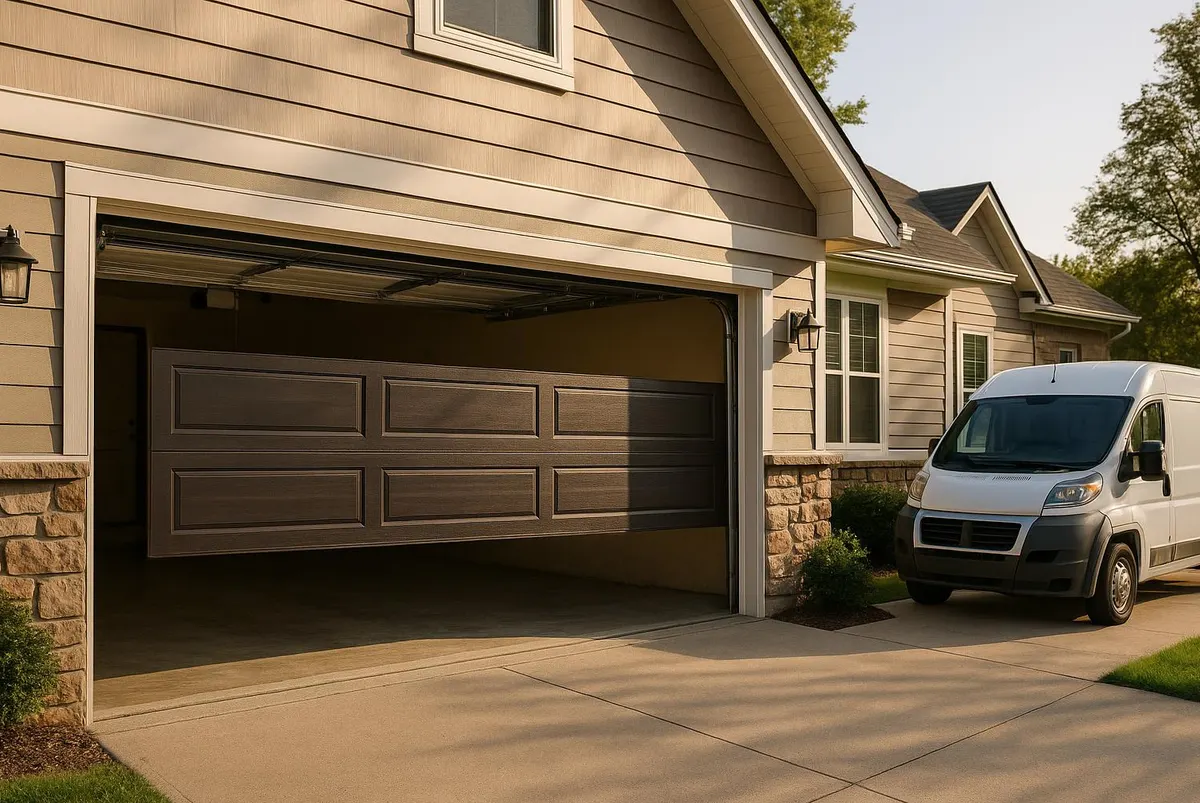
Short answer: yes, it's costing you real money
If your garage is attached to the house and the door has gaps, worn seals, or a warped panel, you are paying to heat and cool outside air. The garage shares at least one wall with living space, often a laundry room, bonus room, or the wall behind the kitchen. When that garage runs 15-20 degrees hotter than the house in July, your AC fights that heat transfer all day long. Settle the argument: it's not just about comfort in the garage. It's about the energy bill for the whole house.
Why this matters more in an attached garage
A detached garage can run hot or cold all it wants and your utility bill never notices. An attached garage is different. Heat moves through shared walls, through the door connecting garage to house, and through ductwork or water heaters that sometimes sit in the garage itself. If your water heater or HVAC air handler is out there, a leaky garage door is feeding hot, humid air straight at equipment that's trying to do the opposite job.
In this part of Florida, that heat load is heavier than most places. Summers run hot and humid for months, not weeks, and afternoon downpours push moisture into every gap. A door that seals tight in January can swell and gap by August once humidity gets into the wood or the weatherstripping softens and compresses unevenly.
Where the leaks actually come from
Most leaky garage doors aren't leaking everywhere. They're leaking in a few predictable spots:
- Bottom seal (astragal): this is the first thing to wear out. UV exposure and hot pavement dry it out and crack it, and over a few years it stops hugging the floor. Run your hand along the bottom on a sunny day and you'll often feel moving air.
- Side and top weatherstripping: the vinyl strips in the track frame compress over time. Salt air near the coast speeds this up because it degrades rubber and vinyl faster than inland air does.
- Panel gaps from warping: humidity swings cause wood and even some steel composite doors to swell slightly, which throws off how panels meet. A door that used to close flush can develop a visible gap at a seam after a few humid seasons.
- Uninsulated doors: a single-layer steel door with no insulation has almost no R-value. Even with perfect seals, it transfers heat directly. This is a different problem than air leaks, but it stacks on top of them.
- Off-track or misaligned doors: if the door doesn't sit square in the frame, no amount of new weatherstripping will seal it. This shows up as one side sealing fine and the other letting daylight through.
How to check it yourself tonight
You don't need tools for the first pass. Close the garage door at night and turn on the inside garage light. Walk the perimeter from outside. Any light leaking around the edges is air leaking too. During the day, run your hand slowly along the bottom seal and both side seals while someone holds the door shut. Cool or warm air moving past your hand means the seal isn't doing its job.
If you want a number instead of a feeling, a $15-25 incense stick or a smoke pencil will show you exactly where air is moving in or out. Hold it near a seam with the garage closed and the AC running in the house; drifting smoke tells you where to focus repairs.
What's worth fixing, and what's worth replacing
A worn bottom seal or side weatherstripping is a cheap, high-value fix, typically in the $20-75 range for materials if you're comparing to a full door replacement. It's the first thing to check before assuming the whole door is the problem.
A warped panel or persistent misalignment is a different story. You can reseal around a warped section all you want, but if the panel itself doesn't sit flat, air will keep finding a way through. At that point you're choosing between a panel replacement or, if the whole door has reached the end of its life, a full replacement with an insulated door rated for wind load, which matters here given the area's storm codes.
Insulated doors cost more upfront but do two jobs at once: they cut the direct heat transfer through the door itself, and most insulated models come with better factory seals and tighter tolerances than older uninsulated doors. If your garage holds equipment or finished space above it, that's often worth the upgrade even before you weigh in the energy savings.
When to call Precision Garage Door of Santa Rosa Beach
If you've checked the seals yourself and still feel air moving, or the door looks fine but won't sit flush no matter how you adjust it, that's worth a technician's eyes. A Garage Door Maintenance & Tune-Up covers exactly this: checking alignment, inspecting weatherstripping and the bottom seal, testing balance, and catching the kind of panel warping or hardware wear that's easy to miss from the driveway. If the fix turns out to be bigger, like a panel that's swollen beyond sealing or a door that's simply too old to seal properly anymore, we can walk you through Garage Door Panel Replacement or New Garage Door Installation options built for this area's heat, humidity, and wind-load requirements.
If your garage runs noticeably hotter than it should, or your energy bills have crept up and you can't explain why, call Precision Garage Door of Santa Rosa Beach. We serve homeowners throughout Santa Rosa Beach, Destin, Miramar Beach, and along the 30A area, and we'll tell you straight whether you need a seal, a panel, or a new door.